
See how a screening system reads your CV, before an employer does.
RezoCV tailors your CV or resume to the job in front of you. It reads the posting, runs an ATS audit scoring your CV against it, rewrites your experience for that specific role, drafts the cover letter, and rehearses the interview with you. It never invents experience you do not have, and it never applies on your behalf.
Three-day trial, no card required. Cancel any time. After that, a complete application (audit, rewritten CV, cover letter and screening answers) costs about €1.
Two roles have no end date, so the parser reads them as one job.
One job, one flow
From the morning deck to pressing Apply.
- ~€1
- Guessing why you were rejected costs nothing and teaches nothing. Finding out costs this
- 4
- parts of an application nobody helps you with. The CV was only ever the first
- 0
- sentences you would have to defend and could not. It writes nothing you did not do
- 11
- Applications go quiet and you forget which. Every one sits at a named stage instead
Every figure is arithmetic over the published plans or a property of the product. None of them is a claim about results.
Sending more job applications is not the answer
Most job searches do not fail for lack of effort. They fail because two hundred near-identical CVs went out, a few hundred other people did the same thing, and nobody on the other side had time to read any of them properly.
The tools built for this mostly make that worse. Unlimited resume scans are sold as generosity, and what they actually encourage is applying to more roles, faster, with less thought about each one. That is the behaviour that produced the pile nobody can read. It is also why the five separate jobs inside an application matter more than how many you send: volume fixes none of them.
RezoCV is built the other way round, on purpose. Plans are sized for preparing a handful of applications properly rather than firing off fifty. The ATS audit scores your CV against the job posting in front of you, and when the honest answer is that the gap is too wide, it says so instead of helping you paper over it. Where your CV claims a result but gives no figure, the rewrite leaves a bullet without one rather than inventing a percentage you would have to defend in the interview. A CV that wins an interview you cannot survive has cost you a week and an employer's goodwill.
The same logic applies to keywords. Using the employer's own words for work you genuinely did is accurate writing; repeating them twenty times to game an applicant tracking system is not, and it reads as desperate to the human who opens the file. What an ATS actually reads goes through where that line sits.
Fewer applications, each one worth reading. That is the whole idea, and every other decision here follows from it.
How it works
-

Bring your CV once
Upload a PDF, or import your LinkedIn profile from the export LinkedIn gives you. Every section stays editable, and an import never overwrites what you wrote.
-

Paste the job
A link or the text. RezoCV pulls out what the role actually requires, separates the must-haves from the nice-to-haves, and scores your CV honestly against it.
-

Edit the pack
A rewritten CV in your own voice, a cover letter that cites something real from the posting, and draft answers to the screening questions. Every line opens in an editor first, and what you save is what gets sent.
-

Rehearse, then apply
Sit a mock interview with follow-up questions and a critique of each answer. Then you copy the documents into the employer's form and press Apply.
Jobs that come to you
On a paid plan you do not have to go looking. Every morning Discover holds a deck of postings already scored against your CV, the best first, and you decide on each one in a second.
A deck every morning
Up to 60 postings a day on the monthly plan and up to 120 on the quarterly and annual ones. Only postings scoring 60 or more become cards, so a thin day shows fewer good cards rather than long shots. Browsing the deck costs no credits; preparing an application from a card costs the usual 36.
Swipe, or use the keyboard
On a phone, right to save, left to pass, up for the details. On a computer the same with buttons or the arrow keys, and a grid to see the whole day at once. Filter by remote, by how recently it was posted, by score, and leave internships out. A saved card goes straight to Apply.
Where the postings come from
Public sources only: France Travail, Adzuna, Arbeitnow, Remotive, and employers' own career pages on Greenhouse, Lever, Ashby, Workable, Recruitee, Personio and SmartRecruiters. Not LinkedIn and not Indeed, whose terms forbid it. Each card links to the employer's own posting.
Your CV still stays with you
The overnight search runs on a few job titles worked out from your CV, such as “Data Engineer”, never on the CV itself. The CV is sent only when you open the app, to score what is new, and it is not kept after that request.
What it will not do
RezoCV does not invent achievements, inflate a number, or claim a skill you have not shown. Where your CV gives no figure for a claim, the rewrite says what you did without one instead of filling the gap with a plausible number. The same rule binds the rewrite button in the editor: a passage with no number in it comes back with no number in it. What it tells you about an employer comes from the public company registers and that employer's own job board, with a source on each line, never from what a model half remembers about a company name. It does not submit applications for you, and it does not mass-apply. A CV that wins an interview you cannot survive is worse than no interview.
The draft is a draft, not a verdict
A generated CV you cannot change is somebody else's application with your name on it. You know things the model does not: which of two employers the posting really came from, what that project was actually called, which number you are willing to defend out loud in a room. So every line RezoCV writes opens in an editor before it goes anywhere.
Every line, editable
Each bullet, the summary and the whole cover letter have an Edit button that opens a full writing surface, with Save and Cancel. Nothing is committed until you save it, and what you save is what goes into the download and the application pack, not the version we drafted.
A rewrite that cannot invent
Its choices are the ones CV writing convention asks for rather than tone words: put the result first, start with a verb, show the scope, plainer, shorter. A passage with no number in it comes back with no number in it. There is deliberately no "make me sound senior" button, because the only way a model produces that from one paragraph is to turn work you contributed to into work you owned.
The letter shows what it believes
Before it writes a word it answers three questions in front of you: what situation this company is in, what problem the role was opened to solve, and which of your experiences helps solve it. You can correct any of them first. A letter built on a wrong premise reads as generic however well it is written, and until now the premise was invisible.
Facts with a source, or none
Ask about an employer and it reads the public company registers, not the web: the French state's company search, Companies House, SEC EDGAR, and that employer's own job board. Every line carries the source it came from and you keep or drop each one. A wrong fact about an employer arrives in front of somebody who works there, and it damages you rather than us.
Every one of those points the same way: an application worth reading is one a person actually stands behind. Your cover letter now leaves on the same letterhead as your CV, as a document rather than a text file, for the same reason.
Keeping track of where everything stands
A search falls apart in the gaps: the role you meant to follow up on, the deadline you only half remembered, the application you are no longer sure you sent. The Tracker is one board holding every role you have saved.
- 1Discovered
- 2Drafting
- 3Applied
- 4Interview
- 5Offer
Pricing
Prices are in euros. VAT or local sales tax is worked out and added at checkout by our reseller, so the total shown before you pay is the total you pay.
One customer rating so far: 5 out of 5. A single review, on a product still finding its first users. visible on the checkout page.
€19 / month
About 19 applications a month, and up to 60 matched jobs a day.
Renews monthly. Cancel any time.
€48 / 3 months
The same monthly allowance, billed quarterly, and up to 120 matched jobs a day.
About €16 a month. A search usually runs longer than one.
€89 / year
The same monthly allowance, billed once a year, and up to 120 matched jobs a day.
About €7.42 a month.
Pay with the same email address as your RezoCV account, so the credits land on it. Already signed in? Buy from inside the app instead and it is matched for you.
Free trial: your first complete application, on us. Three days, no card required. Confirm your email and reading the posting, auditing your CV against it, the rewrite and the cover letter all cost nothing, plus 6 credits to import your CV to start. That is 42 credits of work, and it is reserved for that one application: a plan is for the ones after it, and for finding the postings. Anything unused expires with the trial.
Compare the plans
| Feature | Free trial | Monthly | Quarterly | Annual |
|---|---|---|---|---|
| Credits | 42 | 700/mo | 700/mo | 700/mo |
| Cost per month | Free | €19 | €16 | €7.42 |
| ATS audit and fit score | Yes | Yes | Yes | Yes |
| CV and LinkedIn import | Yes | Yes | Yes | Yes |
| Job board search | Yes | Yes | Yes | Yes |
| Daily job feed, scored against your CV | – | 60/day | 120/day | 120/day |
| CV rewritten for the role | – | Yes | Yes | Yes |
| Cover letter | – | Yes | Yes | Yes |
| Mock interview | – | Yes | Yes | Yes |
| Tracker, exports, both languages | Yes | Yes | Yes | Yes |
| Cancel any time | No card | Yes | Yes | Yes |
Every paid plan unlocks the same features and the same monthly credits. The one thing that grows with the plan is the daily job feed: up to 60 matched postings a day on monthly, 120 on quarterly and annual. A dash means the trial is too small to reach it, not that it is unavailable. A complete application costs 36 credits and the trial covers exactly one of them, plus the 6 to import your CV. Finding the postings is what a plan adds.
Need more inside a period? Credit packs are a one-off purchase and do not expire while your account is open:
| Pack | Price | Roughly |
|---|---|---|
| 250 credits | €10 | 6 applications |
| 700 credits | €22 | 19 applications |
| 1,800 credits | €49 | 50 applications |
Work is priced in credits rather than in applications because the tasks cost very different amounts to run: a full mock interview uses roughly twice what a whole application pack does. A complete application (reading the posting, the audit, the rewrite, the cover letter) costs 36 credits. The app shows what every action costs before you spend it, and your balance and history sit in Settings.
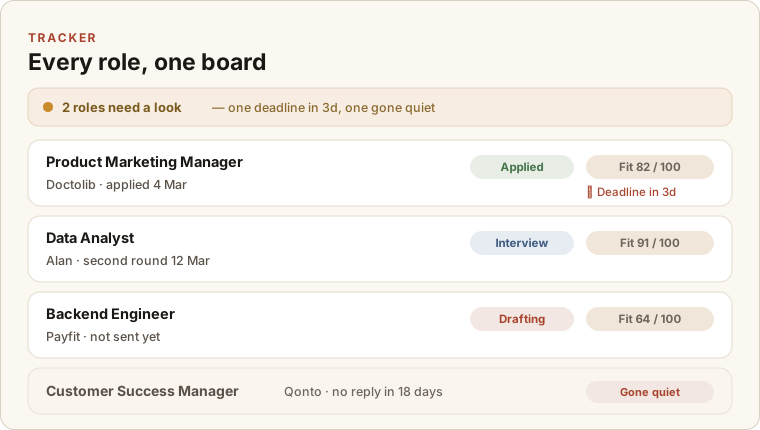
Four saved roles, and the two the board wants you to look at.
Every role, one board
Eleven states, from Discovered through Drafting and Applied to Interview and Offer, with Rejected, Withdrawn and Archived for the ones that end. Each row keeps the fit score the audit gave it, so a board you have not opened in a week still tells you where to spend the next hour.
It tells you what needs a look
Put a closing date on a role and it comes back to you before it passes. In the iOS and Android apps that is a notification scheduled on your phone rather than held on a server; in a browser it is a banner waiting the next time you open RezoCV. Roles you applied to and heard nothing about for ten days get flagged too, along with anything closing in the next three days. Those two numbers are the whole rule: nothing here predicts your chances, because nothing here has the data to.
What you actually sent them
The tailored CV, the cover letter, the audit and the interview notes are kept beside the row, not just the company name. When a reply finally arrives three weeks later, “what did I send these people?” has an answer. And Withdrawn is deliberately separate from Rejected: after a bad month, the difference between forty refusals and twenty refusals plus twenty jobs you turned down yourself is most of what you need to see.
The reply comes months later
By the time an interview is offered, the posting is closed and you have forgotten what you claimed. Every row keeps a Prep interview button that opens the mock interview built from that posting and that version of your CV. The analysis you already paid for waits where you will need it, not where you bought it.
- A registered French business. Not an anonymous site: the company, its address and its registration are on the legal notice, as French law requires.
- Your CV stays on your device. Unless you turn on the profile backup. It reaches an AI provider only when you ask, on terms that exclude training, and deleting your work deletes our copy.
- Processed and stored in the EU. A French model provider, a French mail provider, your tracker in the Netherlands. Every processor is named, with its country.
- 14 days, full refund, no reason needed. Beyond the statutory withdrawal right. The terms are written down.
Refunds
14 days, full refund, no reason needed. Write to support@rezocv.com within 14 days of your purchase and you get all of it back. The details, and your statutory right of withdrawal under EU and French law, are on the refunds page.
Questions
Does it apply to jobs for me?
No, and it is built not to. RezoCV prepares everything and lays the fields out ready to copy. You paste them into the employer's own form and press Apply yourself. Mass applying is what makes an application worthless, and it usually breaks the job board's own terms.
Will it make things up about me?
It is written not to. The rewrite works only from what your CV and your profile already say. Where a claim would normally carry a number your CV does not give, it writes the line without one rather than inventing it, and it tells you which keywords from the posting it deliberately left out because your history does not support them.
Can it read my LinkedIn profile from its URL?
No, and it will not pretend to. LinkedIn blocks that, and has taken legal action against services that did it anyway. Instead you import the file LinkedIn gives you: either Save to PDF from your own profile, or the data export from Settings, Data Privacy, Get a copy of your data. The data export costs nothing to import, because it is already structured and needs no AI to read.
What happens to my CV?
Your profile is stored on your own device. Your CV text is sent to an AI provider when you ask for an audit, a rewrite, a cover letter or an interview, and we do not keep it after the answer comes back. Who the providers are and where they are is in the privacy policy.
Can I cancel?
Yes, any time, from Settings in the app. You keep access until the end of the period you have already paid for, and you are not billed again.
Who am I actually buying from?
Payments are handled by Gumroad, which is the seller of record: they take the payment, work out the VAT and appear on your statement. The service itself is provided by Navid Taheri. Both are named in the terms and the mentions légales.
From the blog
4 Strategic Questions to Ask at the End of a Job Interview
Use four strategic questions at the end of a job interview to understand team stability, define success, uncover constraints, and assess fit before you accept an offer.
Does your CV sound AI-written? Check these signals before you apply
AI detectors cannot prove authorship. The more useful check is whether your CV or cover letter sounds generic, unsupported or unlike the experience behind it.
How to audit and rewrite your LinkedIn profile with Claude for Chrome
A practical workflow for diagnosing LinkedIn positioning, rewriting the sections that matter, and keeping every claim tied to evidence you can defend.