
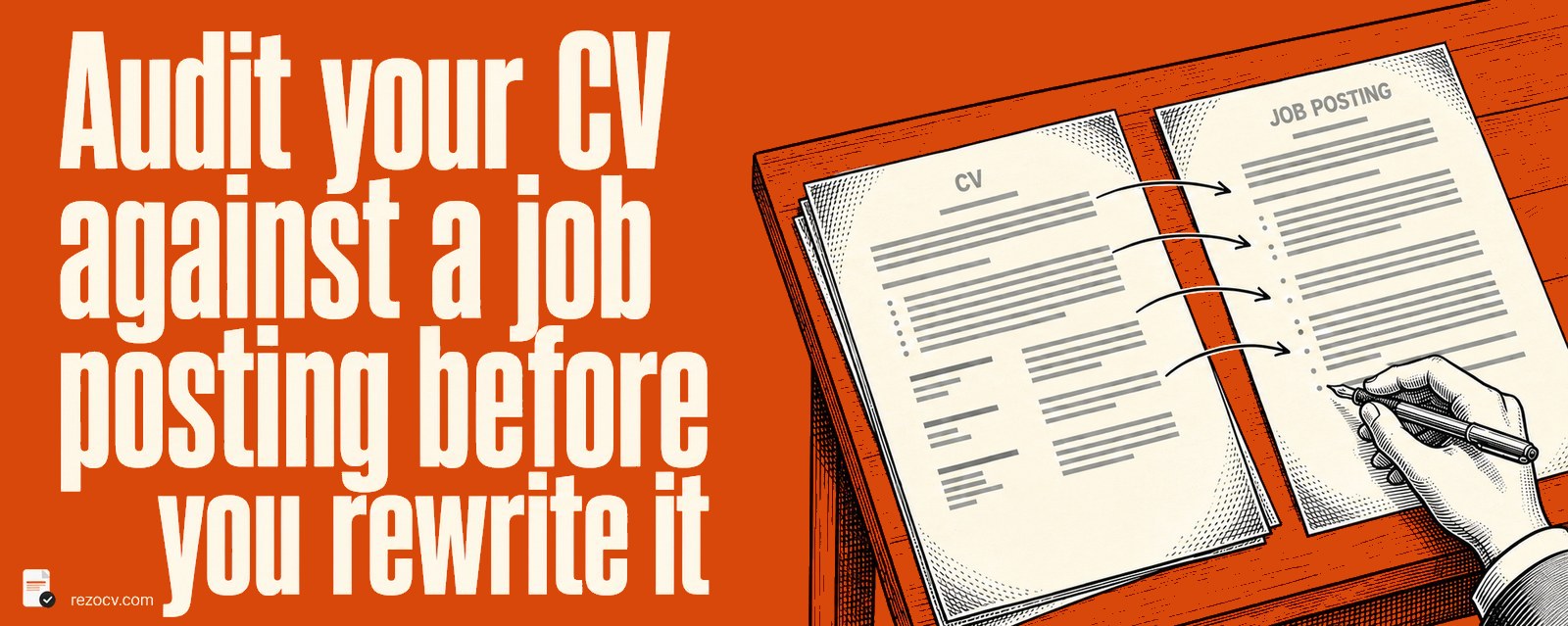
Short answer: before rewriting anything, build a table with four columns: the requirement, the evidence in your CV, how strong that evidence is, and what you will do about it. Requirements with strong evidence move up the page. Requirements with partial evidence get described accurately, not upgraded. Requirements with no evidence stay off the CV. Most of the rewriting decides itself once the table exists.
How to tailor your CV to a job posting makes the case that tailoring is a reordering problem rather than an invention problem. This article is the other half: the actual procedure, on one real vacancy.
The order matters more than it looks. Most people open their CV first and start rewriting, which means every decision is made while looking at the document they are attached to. The table comes first for the same reason a builder measures before cutting.
Read the posting as a list of requirements
A job posting is two documents printed as one. Part of it is marketing about the company. Part of it is a specification. Only the second part is useful here.
Go through it once and pull out four things:
- Required qualifications
- Preferred qualifications
- Responsibilities, meaning what this person does on a Tuesday
- Terms, tools and skills that appear more than once
That last one is the most revealing and the most often skipped. A posting that mentions forecasting, customer research and cross-functional planning three times each is telling you what the job is, whatever the title says.
Essential is not the same as preferred
Look for the words that mark a hard requirement: required, must have, essential, minimum. Then look for the softer ones: preferred, desirable, a plus, nice to have.
This distinction decides where your first page goes. Space on page one is the scarcest thing in the whole document, and it should be spent on the requirements that would remove you from consideration, not on the ones that would have been a bonus.
Recording the wording is not the same as having the evidence
Writing down "stakeholder communication" because the posting says it is the easy half. The real question is the next one: where in your history is that?
It might be a project where you presented recommendations to a client, or coordinated three teams through a deadline, or wrote the report a decision was made from. Any of those is evidence. The phrase on its own is not.
Build the evidence table
Four columns, one row per requirement that matters:
| Requirement | Evidence in your CV | Strength | What you will do |
|---|---|---|---|
| Named in the posting | The specific project, role or result | Strong, partial, or none | Move up, clarify, add detail, or leave out |
Fill in the second column with something specific enough to point at. "Project management" is not evidence. "Ran the Q3 migration, four people, finished two weeks late" is.
For each row, four questions answer the strength column:
- Where have I done something like this?
- What was my part in it, precisely?
- What changed because of it?
- Can I explain the method and the context out loud?
If the fourth answer is no, the evidence is weaker than it looks on paper, whatever the first three say. An interview will find that out.
About numbers
Use a number only when it is real and you can say where it came from. A figure you cannot source is worse than no figure, because it is the thing an interviewer will ask about first.
If you know a result happened but never recorded the number, note it somewhere in your working draft and go find it before the CV is finished. What must not happen is a bracket surviving into the document you send: tailoring is a reordering problem covers why a placeholder in a finished CV reads worse than an honest sentence with no number in it at all.
A bullet without a figure can still be strong. "Rebuilt the month-end reporting process, cutting the manual steps it needed" says something true and specific. It is a better sentence than an invented percentage.
Rows with nothing in the second column
A missing requirement is not automatically a reason to walk away. It is a reason to make a decision instead of drifting.
You can close it with a course or a portfolio project. You can point at genuinely adjacent experience and describe it as adjacent. You can explain it in the cover letter. Or you can decide this is not your role, which is also a real answer and cheaper than three weeks of silence.
What you cannot do is turn "familiarity with" into "expertise in", or describe two months of exposure as experience. That converts a gap you could have explained into a credibility problem you cannot.
Rewrite only what the table tells you to
With the table filled in, most editing decisions are already made.
A useful accomplishment bullet has four parts, and they can usually fit in one sentence:
- What you did
- The problem or context it sat in
- The method, tool or collaboration involved
- The verified outcome
"Responsible for reports" has none of them. "Prepared weekly operational reports for the support team, consolidating ticket trends and flagging recurring issues for review" has three, and does not claim a result it cannot support. That is a fair trade.
Borrow the employer's words only when they are true
If a posting uses the standard name for something you have actually done, use that name. It removes a translation step for the reader, and on a first pass of a few seconds that matters.
But a term you cannot explain in an interview is a liability that arrives later, when it costs more. The test is simple: could you answer a follow-up question about it without hedging?
Emphasis, not reconstruction
Tailoring is usually moving things, not writing new things. A relevant project goes higher. A role-related bullet gets a sentence more. A job from eight years ago loses two.
And keep it readable. A CV stuffed with terms until a human cannot skim it has optimised for the wrong reader: what an ATS actually reads explains why the machine was never the audience that rejects you.
The rest of the application comes from the same table
Once the evidence table exists, the other documents are cheaper to write, because the thinking is done.
The cover letter should not restate the CV in paragraphs. Take one or two rows with strong evidence and give them the context a bullet has no room for: name the role and why it interests you, connect one supported experience to a central requirement, say what that lets you contribute, and close. Anything that contradicts the CV is worse than nothing, so check dates and titles against it before sending.
Screening answers are usually testing the same rows in a different format. Answer the question first, then give one concrete example. Where your experience is thin, say so plainly and describe what is adjacent. A short honest answer survives a follow-up; a padded one does not.
Interview preparation is the table read aloud. For each important claim: the situation, your specific part, the action, the result and what you learned from it. Expect to be asked. If your CV says you led something, be ready to say who was involved, what you decided and how it was judged.
The five jobs of an application covers why these pieces have to agree with each other, and what happens when they do not.
What a tool in this category should refuse to do
Software is genuinely good at the mechanical half of this: pulling requirements out of a posting, checking them against your CV, noticing a term you claimed but never evidenced, drafting a first pass.
What it should refuse:
- Inventing an achievement, an employer, a qualification or a responsibility
- Producing a number you did not give it
- Turning a skill you mentioned once into claimed expertise
- Sending anything without you reading it
- Encouraging volume over fit
RezoCV audits and rewrites a CV against a posting, drafts cover letters and screening answers, and runs mock interviews. It does not invent experience, and it does not apply on your behalf: you click submit. Its output is scrubbed of fill-in-the-blank markers before you see it, precisely because a bracket left in a finished CV is worse than a sentence with no number in it.
Check the current pricing and the privacy terms before you start, since both change.
The last read before you send
- The role title and company name are right, in every document
- The requirements that matter are findable in the first few seconds
- Relevant experience is prioritised, not merely present
- Every number is real and you know its source
- No placeholder or bracket survived into the final file
- Terms from the posting are ones you can defend out loud
- Nothing unsupported is presented as a strength
- The cover letter adds evidence rather than repeating the CV
- Screening answers agree with the CV on dates, titles and results
- Links and contact details work
- The file is readable on a screen and after export
- You have read the whole thing once, as the employer will
Questions
How long should the evidence table take?
For one posting, twenty to thirty minutes the first time and less after that. It is slower than opening your CV and typing, and it removes most of the rewriting decisions, so the total is usually shorter.
What if almost every row says "none"?
That is the table doing its job. A posting where you cannot evidence the essential requirements is one to skip or to come back to after closing a specific gap. Knowing that in twenty minutes is the point.
Should I really leave a requirement off if I have no evidence?
Off the CV, yes. That is not the same as never mentioning it. A cover letter can say plainly that you have not done X, and describe the closest thing you have done. What you cannot do is imply it in a bullet and hope nobody asks.
Can I use a placeholder like [ADD NUMBER] while drafting?
In your own working copy, yes, and it is a good habit. It must not reach the employer. RezoCV strips markers like that from its output for the same reason.
Does using the posting's terminology count as keyword stuffing?
Not when the term truthfully describes your work and appears where it belongs. It becomes stuffing when terms are repeated for a machine at the cost of a person being able to read the page.
Is this different from just rewriting my CV?
Yes, and the order is the difference. Rewriting first means deciding while looking at the document you are attached to. The table forces the comparison before the editing, which is when the decisions are still cheap.
Start with one real posting
Pick a vacancy you actually want. Build the table. Fill the second column honestly, including the rows where it stays empty.
Then rewrite only what the table tells you to, and send nothing you could not explain in a room.